
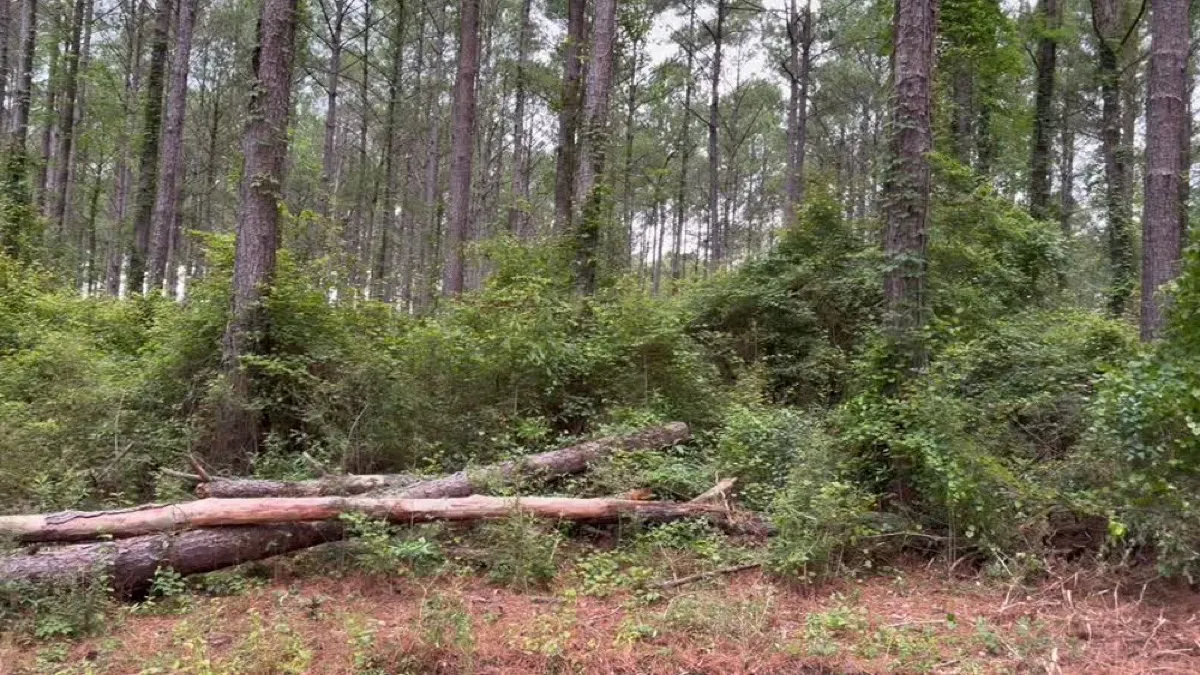
Hurricane cleanup in South Alabama: who clears the trees, what insurance pays, and what it costs
After a Gulf Coast storm the trees on your property are your problem, not the county’s. FEMA’s guidance says debris removal from private property “is the responsibility of the property owner” and is usually ineligible for public assistance. Mobile County spelled it out after Hurricane Sally: owners must place vegetative and construction debris at the curb, and the county’s contractor picks it up from there. Getting it to the curb is the part nobody warns you about.
Here is how the pieces fit, drawn from FEMA, county, insurer, and CDC sources, so you know what falls to you, what insurance may cover, and what the work costs. When a storm leaves a lot buried, our storm cleanup and debris removal crew handles the heavy end, with demolition for anything the storm finished.
Who clears what?
Public right-of-way: the county and its debris contractor. FEMA funds pickup of debris residents place at the curb along publicly used roads.
Private property: the owner. FEMA’s Category A guidance is direct that debris on private property, including private roads, driveways, and non-commercial land, is the owner’s responsibility. It even notes FEMA does not fund removal of broken limbs on private property unless they extend over the public right-of-way and pose an immediate threat. Only in rare, widespread-threat situations does private-property removal become public work, and never to benefit a single owner.
Vacant lots and commercial property: the owner too. Mobile County’s Sally guidance said vacant-lot owners must coordinate getting vegetative debris to the curb, and commercial owners must dispose of their own, with no FEMA reimbursement to the county for it.
What curbside pickup will and will not take
Mobile County’s post-Sally rules are a good template for the next one:
- Storm-related vegetative debris and construction-and-demolition debris only. Not household trash, appliances, electronics, or hazardous waste.
- Placed curbside or in the right-of-way, not in roadways, on sidewalks, or over storm drains.
- Vegetative and construction debris in separate piles. Commingled piles, or piles mixed with garbage or metals, get skipped.
- No self-haul drop-off site was offered.
Baldwin County keeps its own debris management plan through its Emergency Management Agency, and its curbside rules track FEMA’s. Check the county’s storm page for the current one.
What homeowners insurance covers
The line insurers draw is whether the tree hit something covered.
- Tree falls on the house, garage, or fence: covered damage, and removal is covered too, typically up to about $500 to $1,000 per tree depending on the policy.
- Tree blocks a driveway or accessibility ramp: typically covered.
- Tree falls in the yard and hits nothing: removal is generally not covered. Triple-I says policies do not pay to remove trees or landscaping debris that did not damage an insured structure.
- Neighbor’s tree on your house: your own insurer pays you; if the tree was poorly maintained or diseased, your insurer may pursue theirs.
- Rot, decay, or neglect: not covered. Preventive removal is upkeep, not a claim.
What does storm cleanup cost?
| Job | Typical 2026 range | Notes |
|---|---|---|
| Standard tree removal | $385 – $1,100 | Averages $435 – $906 across guides |
| Fallen tree, already down | $75 – $300 each | Far cheaper than standing removal |
| Emergency removal | $450 – $5,000 | Often 2 to 3 times standard rates |
| Storm-damaged tree | $400 – $900 | |
| Stump removal or grinding | $100 – $525 | |
| Debris hauling | $100 – $300 | Per load or job |
| Wood chipping | $75 – $125 per hour | |
| Dumpster rental | $200 – $800 | 10 to 40 yard |
The pattern in every guide: a tree already on the ground costs a fraction of one that has to be brought down, and emergency rates in the days after a storm run multiples of normal. If the tree is down and off the house, the cheapest move is often to wait a week and clear it as land work rather than pay emergency tree-service rates.
The safety part is not optional
The CDC reports roughly 36,000 people a year treated in emergency departments for chainsaw injuries and says the risk “increases after hurricanes and other natural disasters,” when chainsaws come out for downed and partially downed trees. A study of Hurricane Sandy’s aftermath found tree-related injuries rose 67 percent in the quarter after the storm, and a third of them involved chainsaws. Nearly half were struck-by injuries: something falling on someone.
The CDC’s rules for the work: avoid contact with power lines until they are verified de-energized, cut at waist level or below, wear a hard hat, eye and hearing protection, heavy gloves, chainsaw chaps, and ankle-covering boots, keep bystanders two tree lengths back, and watch for spring poles, the bent saplings under tension that release when cut.
For a lot covered in downed pine and hardwood, machine work does in hours what a chainsaw does in days, and nobody stands under a loaded limb to do it. Storm-downed trees also leave the ground full of root balls and stumps, and cleaning those up is land clearing work, not tree-service work.
What we do after a storm
We clear downed timber and debris to the curb, pull the root balls and stumps that a storm leaves behind, take down structures that a storm finished, and reshape ground that washed or rutted. Free quotes, and after a storm we schedule the properties where access or safety is the issue first.